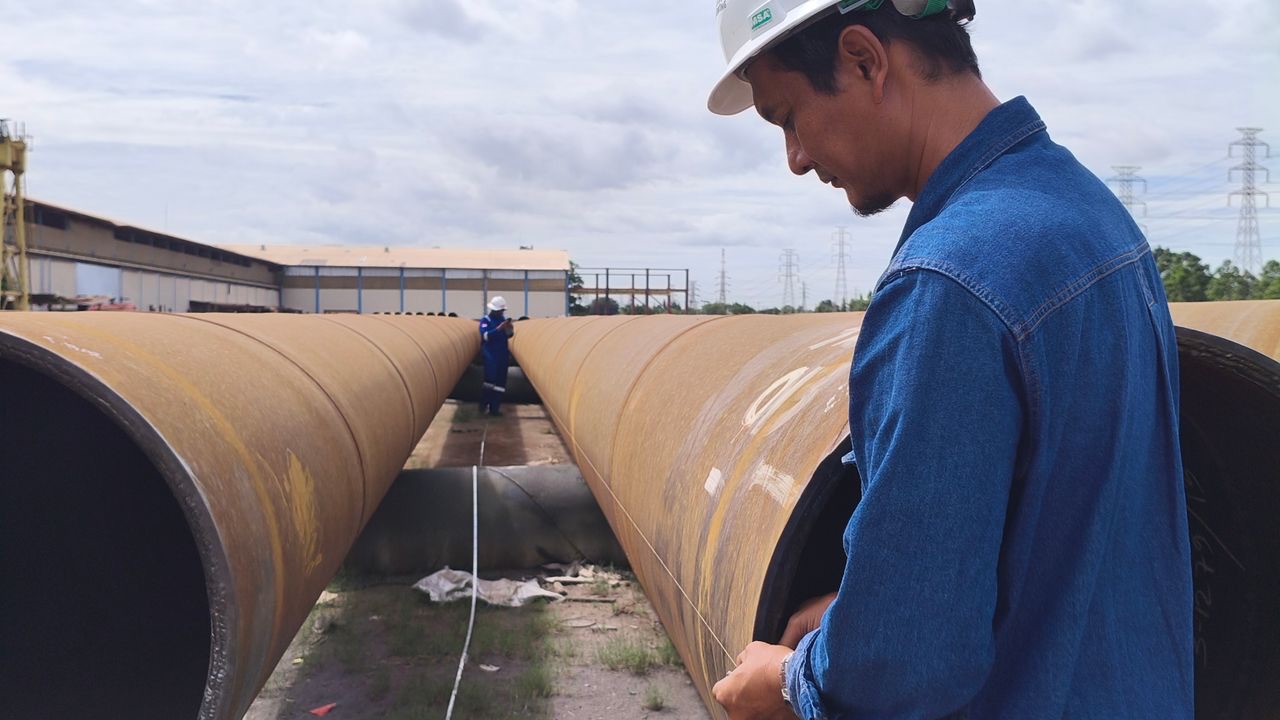
Pipe procurement mistakes rarely look like mistakes until the material arrives on site. The specification looks complete on the purchase order. The supplier confirmed the order. The delivery documentation matches what was ordered. And then someone measures the pipe, or checks it against the engineering drawing, and the problem becomes visible: the wrong wall thickness, the wrong outside diameter, or a pipe that meets one part of the specification and misses another in a way neither party caught.
A significant proportion of these situations trace back to confusion between three related but distinct ways of describing a pipe — nominal pipe size, outside diameter, and wall thickness — and how Schedule 40 interacts with each of them. These are not obscure technical distinctions. They are the basic parameters of pipe specification, and misapplying them creates procurement errors that show up in fabrication, erection, or pressure testing.
Nominal pipe size is not a measurement
The most common source of specification confusion starts here. Nominal pipe size (NPS) is a designator, not a physical dimension. A pipe specified as “NPS 2” does not have a 2-inch outside diameter, a 2-inch inside diameter, or a 2-inch wall thickness. It has an outside diameter of 2.375 inches (60.3mm), which is a fixed dimension that doesn’t change regardless of schedule.
This surprises people who have worked with other product categories where the nominal size is an approximation of the actual dimension. In pipe, the nominal size is a legacy designator that reflects the approximate inside diameter of early iron pipe, before standardization settled on fixed outside diameters. The name stuck. The physical meaning did not.
For pipe up to NPS 12, the outside diameter is larger than the nominal size. At NPS 14 and above, the outside diameter equals the nominal size in inches — NPS 14 pipe has an OD of 14 inches exactly. This is another inconsistency that creates errors when buyers or specifiers don’t distinguish between the nominal size designator and the physical outside diameter.
The practical consequence: a purchase order that specifies “2-inch Schedule 40 pipe” is interpreted by any knowledgeable supplier as NPS 2, Schedule 40, with an OD of 2.375 inches and a wall thickness of 0.154 inches. A buyer who writes this specification expecting a 2-inch outside diameter receives pipe that doesn’t fit their application, through no fault of the supplier who filled the order correctly.
Schedule determines wall thickness, not outside diameter
The outside diameter of a pipe at any given nominal size is fixed. The schedule determines the wall thickness. As schedule number increases — from Schedule 10 to Schedule 40 to Schedule 80 to Schedule 160 — the wall thickness increases and the inside diameter decreases, while the outside diameter stays the same.
This is functionally important for fitting compatibility. All schedule variants of a given NPS pipe share the same outside diameter, which means they accept the same fittings, flanges, and couplings. The threading on a Schedule 40 and a Schedule 80 NPS 2 pipe is cut from the same outside diameter stock. This is intentional — it allows wall thickness (and therefore pressure rating) to be varied without changing the entire piping system’s connection hardware.
The confusion point for procurement is that “Schedule 40 wall thickness” varies with pipe size. A Schedule 40 pipe thickness chart shows that NPS 1/2 Schedule 40 has a wall thickness of 0.109 inches, while NPS 8 Schedule 40 has a wall thickness of 0.322 inches. These are different pipes by every structural measure. Specifying “Schedule 40 wall thickness” without a nominal size conveys no specific dimensional information.
This creates a particular problem when a purchase order refers to wall thickness without specifying the nominal size, or when a buyer specifies wall thickness in millimeters without confirming it matches the Schedule 40 value for the intended nominal size. A 6mm wall thickness is not Schedule 40 for every pipe size — it matches Schedule 40 approximately for some sizes and misses it for others.
ERW and seamless under the same schedule designation
Schedule 40 is a wall thickness designation. It does not specify whether the pipe is seamless or electric resistance welded (ERW). Both manufacturing methods can produce pipe to Schedule 40 dimensions, but they are covered by different material standards and have different qualification requirements for pressure service.
A purchase order that specifies “Schedule 40 pipe” without a material standard — ASTM A53, A106, API 5L, or others — does not distinguish between seamless and ERW, between carbon steel grades, or between the inspection requirements that come with each standard. The supplier selects whatever compliant product is available, which may not be what the engineer specified on the design drawing.
The correct procurement document specifies: the material standard (e.g., ASTM A106 Grade B), the manufacturing method (seamless), the nominal pipe size, the schedule (Schedule 40), and any additional requirements such as heat treatment, end preparation, or testing. Each of these is a separate specification parameter. Combining them into a single descriptor — “2-inch Schedule 40 seamless” — without the material standard leaves the grade, testing level, and applicable code requirements undefined.
Outside diameter vs. nominal size in metric markets
Procurement teams working across both imperial and metric markets encounter an additional confusion point: pipe outside diameters in metric documentation are sometimes listed in millimeters corresponding to the actual outside diameter, not to the nominal size converted to millimeters.
A European engineering drawing may specify a pipe with an OD of 60.3mm and a wall thickness of 3.91mm — which corresponds to NPS 2, Schedule 40. A buyer who searches for this pipe in a supplier’s metric catalog may find it listed under DN50 (the metric nominal designation, which corresponds approximately but not exactly to NPS 2). The outside diameter of DN50 pipe per ISO standards is also 60.3mm, but the wall thickness at a given pressure class may differ from the Schedule 40 value.
Confirming that the OD and wall thickness match — not just that the nominal size matches — prevents this category of error. It requires knowing both the nominal size designator and the actual dimensions, checking them against the applicable standard, and writing the specification in terms of actual dimensions when there is any ambiguity about which standard applies.
What a complete pipe specification looks like
The errors above share a common root: pipe specifications that use shorthand that leaves parameters undefined. The remedy is a specification format that makes each parameter explicit. For Schedule 40 carbon steel pipe in an industrial procurement context, a complete specification includes: material standard and grade, manufacturing method (seamless or ERW), nominal pipe size (NPS), outside diameter in mm for verification, wall thickness in mm for verification, schedule designation, length, end preparation, and any applicable inspection or test requirements.
This level of specification takes more characters in a purchase order than “2-inch Sch 40 pipe.” It also eliminates the ambiguities that create receiving discrepancies, dimensional mismatches in fabrication, and the conversations about who is responsible for the wrong material that follow when a shorthand specification was interpreted differently by the buyer and the supplier.