I’ve lost count of how many buyers have asked me whether seamless black steel pipe comes “pre-protected.” It doesn’t, and that misunderstanding causes real money to change hands for the wrong reasons. The word “black” describes a surface, not a coating. Once you separate what the finish actually is from what a lot of people assume it is, the rest of the buying decision — seamless or welded, which standard, which schedule — gets a lot simpler. Here’s how I walk through it.
What “black” actually means (and what it doesn’t)
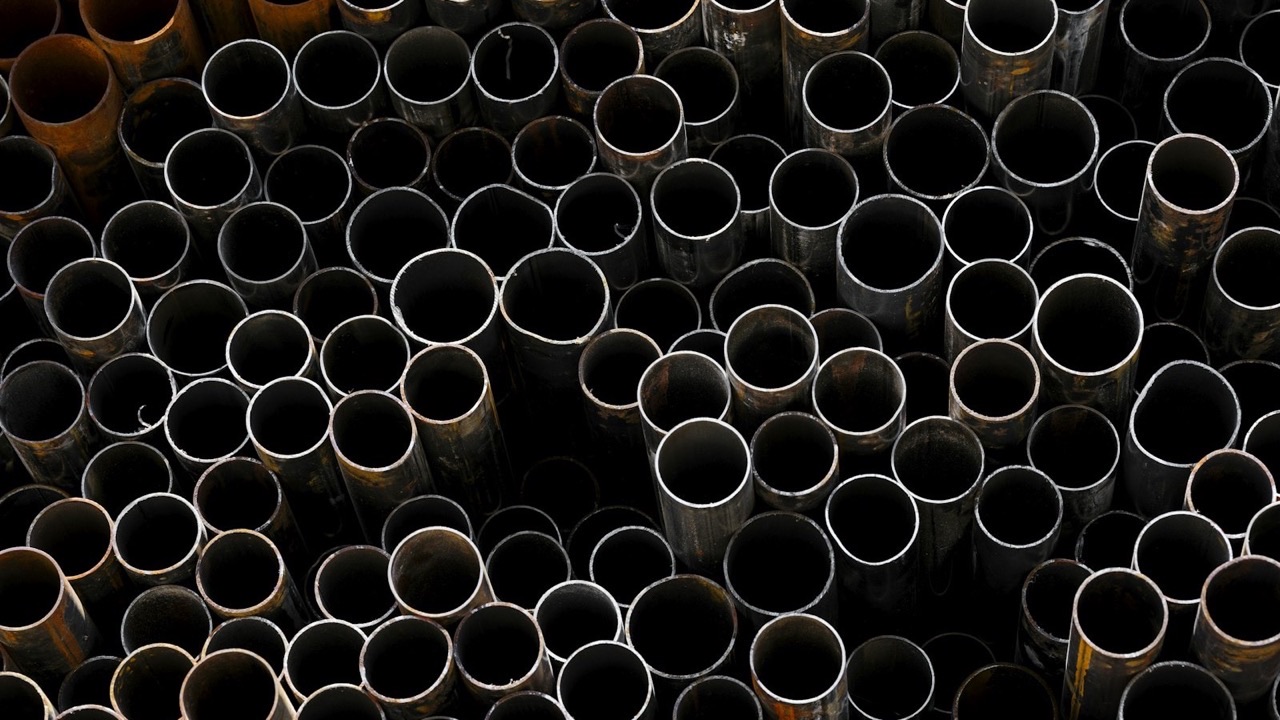
The black on a black steel pipe is mill scale: the dark iron-oxide layer that forms on the surface when carbon steel is hot-rolled. It is not paint, it is not a zinc coating, and — this is the part that trips people up — it is not corrosion protection. Leave a bare black pipe outside in a humid yard for a few weeks and it will start to rust straight through that black surface.
That’s the cleanest way to separate black from galvanized. Galvanized pipe carries a sacrificial zinc coating that protects the steel in wet service, which is why it goes on water lines. Black pipe has no coating, so it lives on gas, steam, oil, fire-sprinkler, and process lines instead. One rule I never bend: don’t put bare black steel on potable water. It corrodes and can discolor the water. If someone’s specifying black pipe for drinking water, something’s gone wrong upstream in the design.
Why seamless, and when welded is fine
Seamless means the pipe is pierced from a solid billet and has no longitudinal weld seam. No seam means there’s no weld line to become a weak point, which is exactly why seamless is the default for high pressure, high temperature, and cyclic service. When a line is going to see thermal swings or sits in a critical service class, I want seamless.
Welded pipe — usually ERW — isn’t the poor cousin, though. For lower-pressure duty, larger diameters, and cost-sensitive structural work, ERW is perfectly sound and noticeably cheaper. It also covers sizes above where seamless gets impractical.
| Seamless (SMLS) | Welded (ERW) | |
|---|---|---|
| Seam | None (pierced billet) | Longitudinal weld |
| Best for | High pressure/temp, cyclic, critical service | Lower pressure, structural, cost jobs |
| Typical size ceiling | ~24–26” | Larger sizes available |
| Relative cost | Higher | Lower |
My shorthand: seamless when the pipe is holding something dangerous under pressure, welded when it isn’t. Above roughly NPS 24–26 you’re usually into welded territory regardless.
Standards and grades: A53 vs A106 vs API 5L
“Seamless black pipe” isn’t a full spec on its own — you still have to name the standard and grade. These are the three that cover almost everything I quote:
| Standard | Product form | Service | Grades |
|---|---|---|---|
| ASTM A53 | Seamless (Type S) and welded | Structural, low-pressure air/gas/water | A, B |
| ASTM A106 | Seamless only, killed steel | High-temperature pressure service | A, B, C |
| API 5L | Seamless and welded line pipe | Oil & gas transmission | B, X42–X70 |
A53 Grade B and A106 Grade B actually share the same headline mechanicals — 60 ksi (415 MPa) minimum tensile and 35 ksi (240 MPa) minimum yield — so buyers sometimes treat them as interchangeable. They aren’t. A106 must be made from killed steel and is built for high-temperature pressure service, commonly up to around 750 °F (400 °C) under ASME piping codes; A53 is the general-purpose choice. And for oil and gas transmission, neither is the right call — that’s API 5L, and on anything serious you want PSL2 for the tighter chemistry and traceability. The good news is that a Grade B seamless pipe is frequently dual-certified to A53 B and A106 B (and often API 5L B) on one MTR, which keeps your options open.
Getting the size and schedule right
Wall thickness comes from the schedule. Schedule 40 is the standard-wall, general-purpose choice; Schedule 80 is thicker-walled for higher pressure, heavier and dearer. The trap on larger sizes is that Schedule 40 and STD, or Schedule 80 and XS, stop being the same wall thickness once you get past a certain diameter. So I always confirm the actual wall in inches or millimeters on the cut sheet rather than trusting the schedule label alone. A “Sch 40” that’s a different wall than you assumed is a surprise you don’t want at fit-up.
How I check seamless black pipe before a PO
The grade string on a quote is where my checking starts, not where it ends. Before I release an order, I run the same short list I’d hand any junior buyer — and for the fuller version I keep the reference guide on Seamless Black Steel Pipe bookmarked rather than trying to remember every detail. My working checks:
- MTR with a real heat number. Chemistry, mechanicals, and test results traceable to the heat. No heat number, no release on a code job.
- Hydro test and NDE. Confirm each length was pressure-tested, and that UT or eddy-current was run where the class calls for it.
- The full spec string on the PO — standard + grade + seamless + schedule + test/cert (for example, “ASTM A106 Gr B, seamless, Sch 80, hydro + UT, MTR EN 10204 3.1”). A bare “black pipe” line item invites the wrong pipe.
- Coating for export. Bare black pipe flash-rusts on an ocean crossing. I want anti-rust varnish or oil and proper bundling specified before it ships.
- Actual wall thickness verified on large sizes, per the schedule note above.
Missing traceability is the one that stalls jobs. I’ve had pipe held at receiving because the paperwork couldn’t tie it to a heat — good steel, wrong outcome.
Real application scenarios
On a refinery revamp, a high-temperature steam header had to be A106 Grade B seamless — the temperature and pressure ruled out both A53 and anything welded, and the dual A53/A106 cert on the MTR kept the inspector happy. A warehouse fire-sprinkler job, by contrast, ran ordinary black pipe because black resists heat better than galvanized in a fire and the pressures were modest. And the one that still stings: an export lot that shipped with no anti-rust coating, arrived with a film of surface rust after weeks at sea, and got rejected on receipt. The pipe was fine underneath. The finish decision sank it. Those three cover most of what actually goes wrong: wrong grade for the temperature, wrong product form for the pressure, or the right pipe let down by finish and paperwork.
FAQ
Is black steel pipe the same as carbon steel pipe? Yes. “Black” describes the uncoated mill-scale surface of a carbon-steel pipe, not a different material. The black layer is iron oxide from hot rolling. It distinguishes the pipe from galvanized (zinc-coated) pipe, but the base metal is ordinary carbon steel.
Is seamless black steel pipe rust-proof? No. The black mill-scale surface is a finish, not corrosion protection. Bare black pipe will rust in humid or outdoor conditions. For wet or exposed service, specify a coating, and remove the scale before painting or welding so the coating or weld bonds properly.
Black steel pipe vs galvanized — which should I use? Use galvanized (zinc-coated) for water and wet service, and black for gas, steam, oil, fire-sprinkler, and process lines. Don’t use bare black pipe for potable water; it corrodes. Galvanized isn’t suitable for gas, so match the coating to the medium.
Seamless vs welded black steel pipe: what’s the difference? Seamless pipe is pierced from a billet with no weld seam, favored for high pressure, high temperature, and cyclic service. Welded (ERW) pipe has a longitudinal seam, costs less, and covers larger sizes and lower-pressure or structural duty. Choose based on pressure, temperature, and budget.
A53 or A106 for seamless black pipe? Use A106 Grade B for high-temperature pressure service — it requires killed steel and is rated to about 750 °F (400 °C) under ASME codes. Use A53 for general-purpose, lower-pressure work. Grade B pipe is often dual-certified to both on a single mill test report.
Can seamless black steel pipe carry water? It can carry water in closed-loop or industrial systems, but it isn’t recommended for potable water because it corrodes and can discolor the supply. For drinking water, use galvanized or a lined/corrosion-resistant option instead.
Bottom line
Seamless black steel pipe earns its place on demanding lines — no seam, strong under pressure and heat, economical for what it does. Just remember that “black” is a finish, not a shield. Name the standard, grade, product form, and schedule on the PO, demand an MTR with a real heat number, and specify a coating if the pipe will sit in the weather. Get those right and the pipe will do its job long after the order’s forgotten.